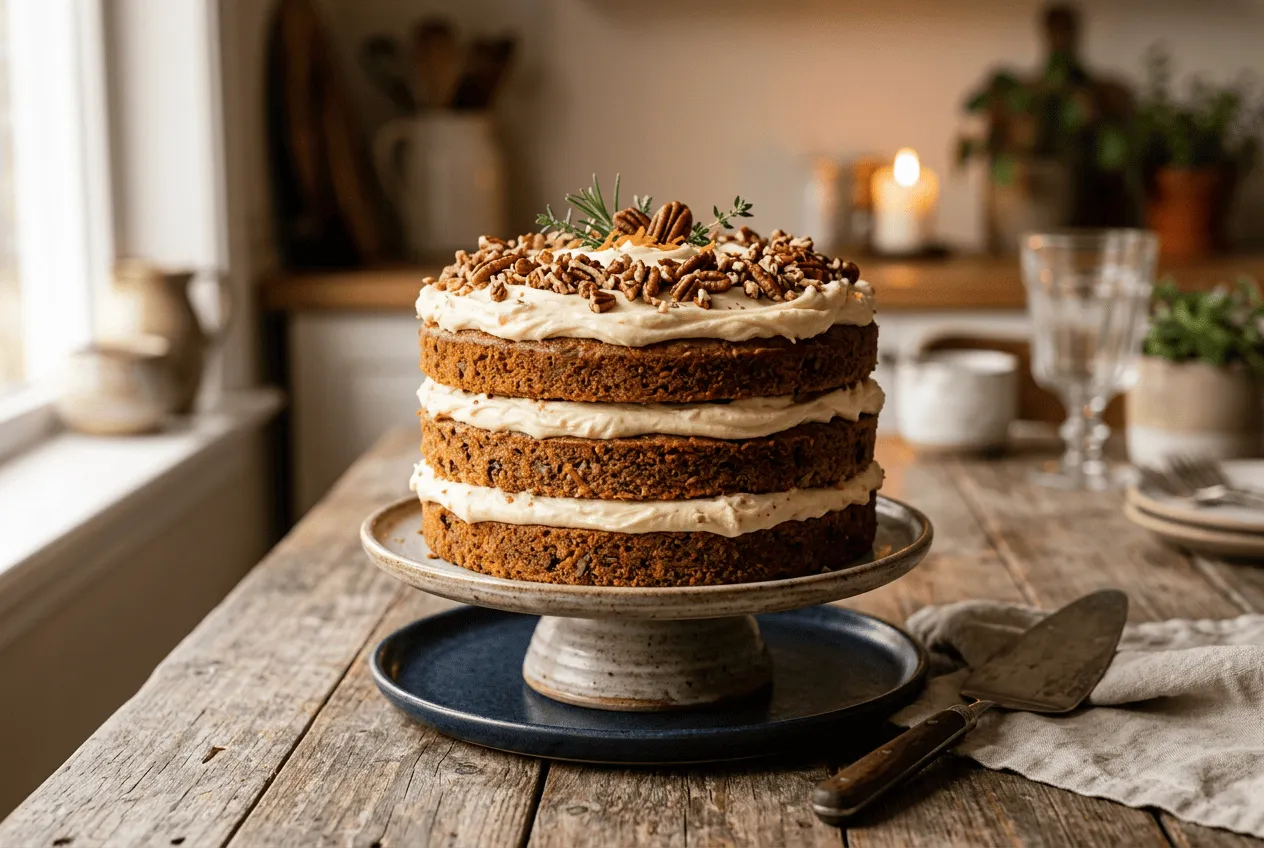
Finding the best carrot cake recipe can often feel like a culinary gamble. Some homemade cakes turn out heavy, oily, and dense, resembling spiced bread rather than a delicate dessert. Others turn out dry and crumbly, relying entirely on heavy sugar frosting to mask their lack of flavor.
This tested-and-perfected carrot cake recipe solves every common baking problem. It delivers three tender, melt-in-your-mouth spiced layers loaded with freshly grated carrots and toasted nuts, all enveloped in a rich, tangy cream cheese frosting that holds its shape beautifully. Whether you are baking for Easter Sunday, a birthday celebration, or an intimate holiday dinner, this dependable recipe guarantees bakery-level results every single time.
WHY THIS IS TRULY THE BEST CARROT CAKE RECIPE
- Incredible Moisture That Lasts for Days:
Thanks to the precise balance of neutral oil and fresh carrots, this cake stays exceptionally tender and moist in the refrigerator for up to five full days. - Rich, Well-Rounded Warm Spices:
Instead of relying on cinnamon alone, this recipe combines ground Saigon cinnamon, aromatic nutmeg, and ground ginger to create a warm, comforting depth of flavor. - Balanced Sweetness:
By using an equal split of dark brown sugar and granulated white sugar, the cake develops deep caramel undertones without tasting overly sugary. - Sturdy Yet Delicate Layers:
The crumb is soft and velvety, yet sturdy enough to stack into a towering, impressive three-layer cake without sinking or sliding.
THE SCIENCE OF MOISTURE: WHY OIL BEATS BUTTER IN CARROT CAKE
A classic question among home bakers is whether to use real butter or vegetable oil. For this specific cake, oil is superior for three scientific reasons:
First, butter is composed of roughly 80 percent fat and 20 percent water. When chilled, butter turns rock-hard. Oil, on the other hand, is 100 percent pure liquid fat that remains completely fluid at both room temperature and refrigerator temperatures. Because carrot cake must be stored in the fridge due to its cream cheese frosting, an oil-based cake stays remarkably soft and moist when served, whereas a butter-based cake becomes stiff and dry.
Second, oil coats flour proteins more effectively, inhibiting excess gluten development and resulting in a softer, more delicate crumb.
Third, neutral oil acts as a clean flavor carrier, allowing the earthy sweetness of freshly grated carrots and warm spices to take center stage without competing with buttery flavors.
ESSENTIAL BAKING TOOLS AND EQUIPMENT (RECOMMENDED GEAR)
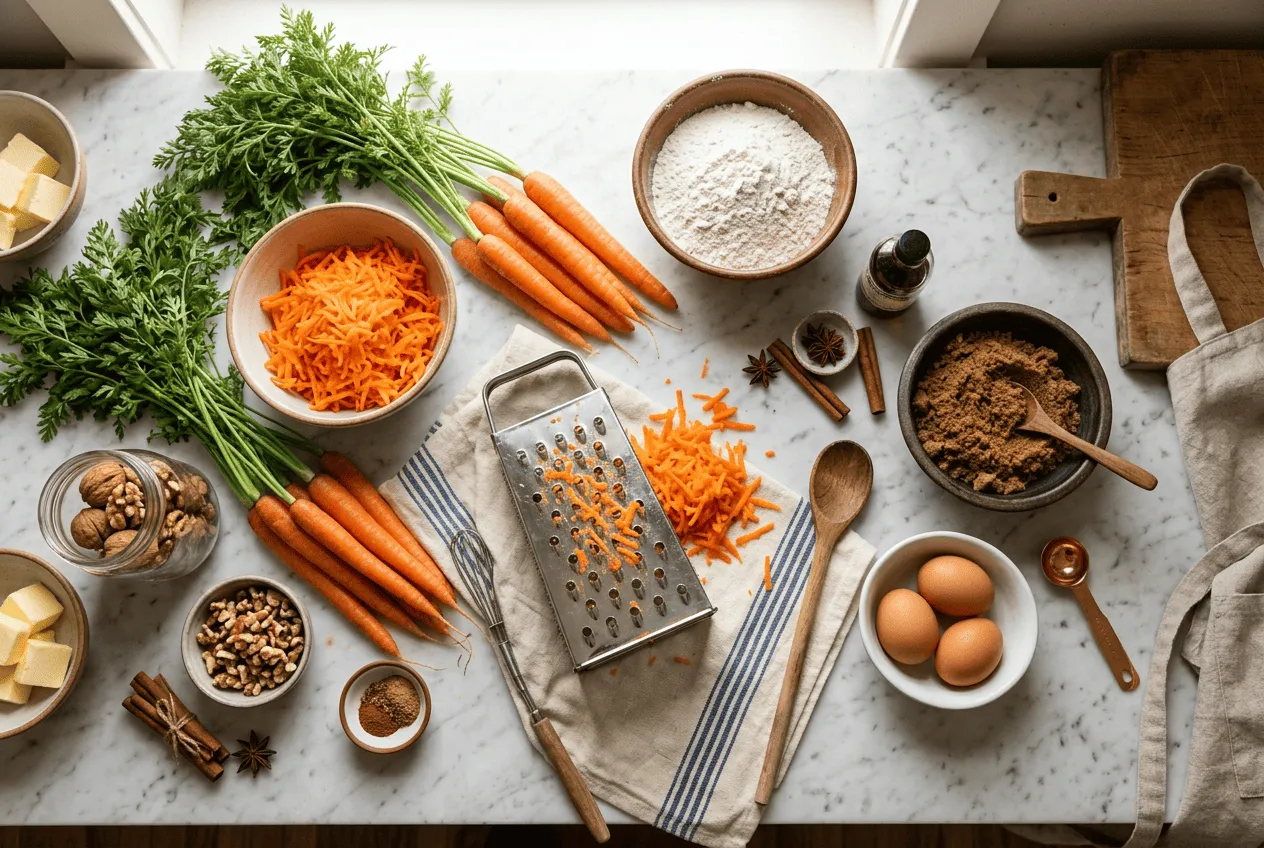
Having the right kitchen tools makes the entire baking process smoother, faster, and far more consistent. Below are the tested tools recommended to achieve flawless results:
- Professional 9-Inch Round Aluminum Cake Pans
Thin, dark, non-stick pans absorb too much heat and scorch the sugary edges of your cake before the center can bake through. Heavy-gauge, light-colored anodized aluminum pans distribute oven heat evenly, giving you flat tops and golden, tender sides.
Recommended: USA Pan 9-Inch Round Cake Pan Set or Fat Daddio’s Anodized Aluminum Round Pans. - Heavy-Duty 4-Sided Stainless Steel Box Grater
Freshly shredded carrots are the secret to this recipe’s moisture. Avoid pre-shredded carrots from the grocery store at all costs. A sturdy box grater with a sharp medium-shred surface makes grating whole carrots fast and effortless.
Recommended: Cuisipro Surface Glide Stainless Steel Box Grater. - Pre-Cut 9-Inch Parchment Paper Rounds
Carrot cake batter is naturally rich in sugars from brown sugar and carrots, which easily sticks to pan surfaces. High-grade unbleached parchment rounds guarantee your cake layers slide out cleanly every single time without tearing.
Recommended: Katbite Heavy Duty 9-Inch Parchment Rounds with Lift Tabs. - Stand Mixer or High-Powered Hand Mixer
While the cake batter can easily be mixed by hand with a simple whisk and spatula, achieving an ultra-smooth, lump-free cream cheese frosting requires mechanical whipping power.
Recommended: KitchenAid Artisan 5-Quart Stand Mixer or Breville Handy Mix Pro. - Angled Offset Spatula and Revolving Cake Stand
An angled spatula keeps your hands clear of the frosting while spreading smooth, even layers. Pairing it with a smooth-spinning cake turntable allows you to frost professional bakery-style swirls in minutes.
Recommended: Ateco 8-Inch Offset Spatula and Ateco Cast Iron Revolving Turntable. - Wire Cooling Racks
Letting baked cakes cool completely in their hot pans causes trapped steam to turn the bottoms soggy. A heavy-duty wire rack provides 360-degree air circulation to ensure your layers cool evenly.
Recommended: Checkered Chef Stainless Steel Cooling Rack.
EXACT INGREDIENTS AND MEASUREMENTS (US CUPS)
For the Spiced Carrot Cake:
- All-Purpose Flour: 2 and 1/2 cups (spooned and leveled)
- Baking Powder: 2 teaspoons
- Baking Soda: 1 teaspoon
- Fine Sea Salt: 1 teaspoon
- Ground Cinnamon: 2 and 1/2 teaspoons
- Ground Nutmeg: 1/2 teaspoon (freshly grated is best)
- Ground Ginger: 1/2 teaspoon
- Ground Cloves: 1/4 teaspoon (optional, for extra warmth)
- Granulated White Sugar: 1 cup
- Light or Dark Brown Sugar: 1 cup (packed firmly)
- Canola Oil or Vegetable Oil: 1 and 1/4 cups
- Large Eggs: 4 whole eggs (at room temperature)
- Pure Vanilla Extract: 2 teaspoons
- Freshly Grated Whole Carrots: 3 packed cups (from about 5 to 6 medium carrots)
- Chopped Pecans or Walnuts: 1 cup (optional; toasted)
- Golden Raisins: 1/2 cup (optional)
For the Bakery-Style Cream Cheese Frosting:
- Brick-Style Cream Cheese: 16 ounces (two standard 8-ounce blocks, slightly cool)
- Unsalted Butter: 1 cup (2 sticks, softened to room temperature)
- Powdered Confectioners’ Sugar: 4 and 1/2 cups (sifted)
- Pure Vanilla Extract: 2 teaspoons
- Fine Salt: 1/4 teaspoon (balances the sweetness)
STEP-BY-STEP BAKING INSTRUCTIONS (FROM SCRATCH)
Step 1: Oven and Pan Preparation
Preheat your oven to 350 degrees Fahrenheit (177 degrees Celsius). Position the oven rack in the center. Grease the bottoms and sides of three 9-inch round aluminum cake pans. Place a 9-inch parchment paper round in the base of each pan, and grease the top of the paper lightly.
Step 2: Toast the Nuts (Optional but Recommended)
If you are adding pecans or walnuts, spread 1 cup of chopped nuts onto a baking sheet. Bake in the preheated oven for 6 to 8 minutes until fragrant and slightly deepened in color. Remove from the oven and allow them to cool completely before adding to the batter.
Step 3: Grate the Fresh Carrots
Peel 5 to 6 medium whole carrots. Using the medium-shredding side of your box grater, grate until you have 3 tightly packed cups. Do not squeeze out the carrot juices; that moisture is vital for the cake.
Step 4: Whisk the Dry Ingredients
In a large mixing bowl, combine 2 and 1/2 cups all-purpose flour, 2 teaspoons baking powder, 1 teaspoon baking soda, 1 teaspoon fine salt, 2 and 1/2 teaspoons cinnamon, 1/2 teaspoon nutmeg, 1/2 teaspoon ginger, and 1/4 teaspoon cloves. Whisk thoroughly for 30 seconds to ensure the leaveners are evenly distributed.
Step 5: Emulsify the Wet Ingredients
In a separate large bowl, combine 1 cup granulated sugar, 1 cup packed brown sugar, and 1 and 1/4 cups oil. Whisk together for about 1 minute until smooth and free of sugar lumps. Add the 4 room-temperature eggs one by one, whisking vigorously after each addition until the mixture looks glossy and slightly lightened. Whisk in 2 teaspoons of pure vanilla extract.
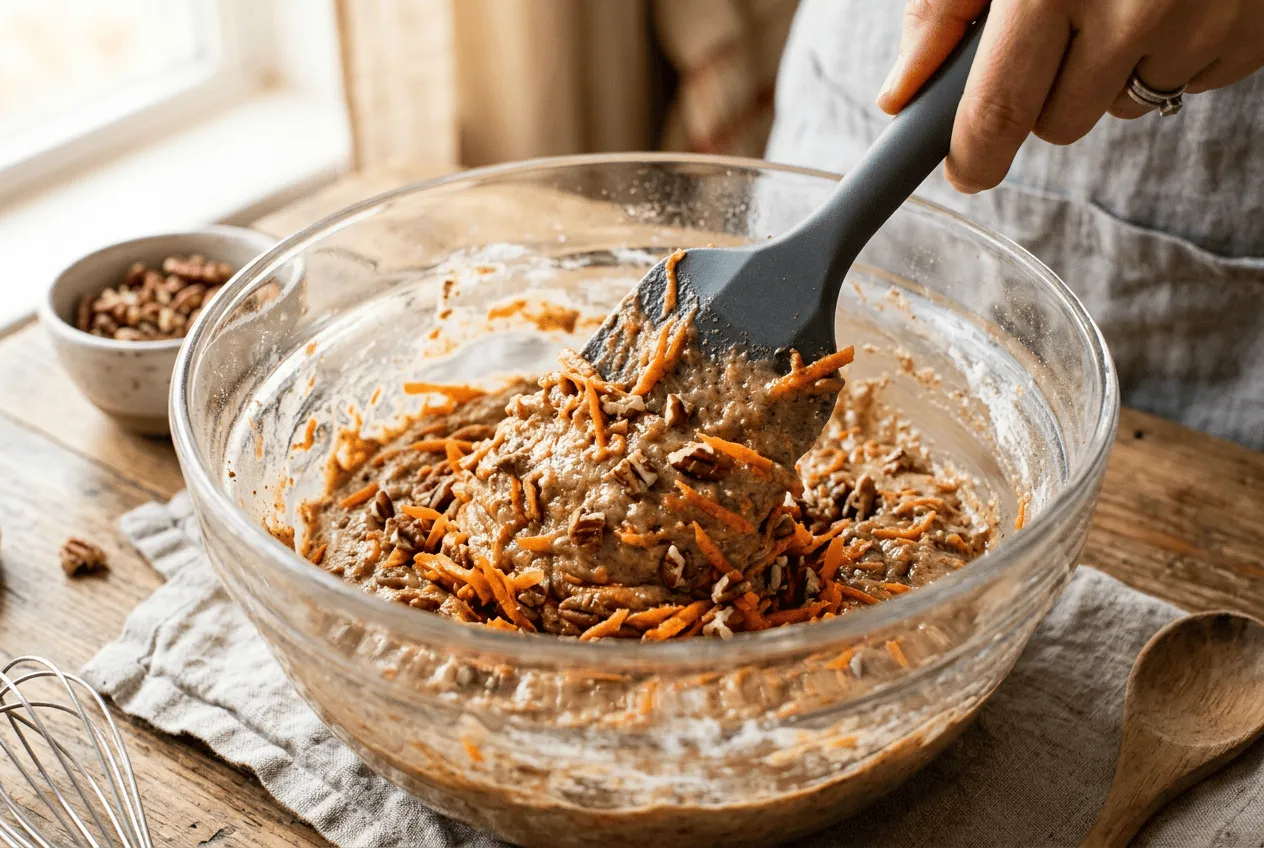
Step 6: Combine Wet and Dry Mixtures
Pour the dry flour mixture into the bowl of wet ingredients. Using a large silicone spatula, gently fold the batter just until mostly combined with a few faint flour streaks remaining. Add the 3 cups of grated carrots and 1 cup of cooled toasted nuts. Fold gently until completely distributed and the flour disappears. Be careful not to overmix, as overmixing makes the cake dense.
Step 7: Divide and Bake
Evenly distribute the batter among the three prepared pans (roughly 18 to 19 ounces of batter per pan). Smooth the tops gently with an offset spatula. Bake at 350 degrees Fahrenheit for 30 to 35 minutes. To test for doneness, insert a wooden toothpick into the dead center of the cake; it should come out clean or with a few moist crumbs attached, but no wet batter.
Step 8: Cool Completely
Place the pans on wire cooling racks and let them rest for 15 minutes. Run a thin knife around the inside edges, then invert the cakes onto the racks. Peel away the parchment paper and let the cake layers cool to room temperature for at least 1 to 1.5 hours before assembling. Never attempt to frost warm cake layers.
HOW TO MAKE PERFECT CREAM CHEESE FROSTING THAT NEVER TURNS RUNNY
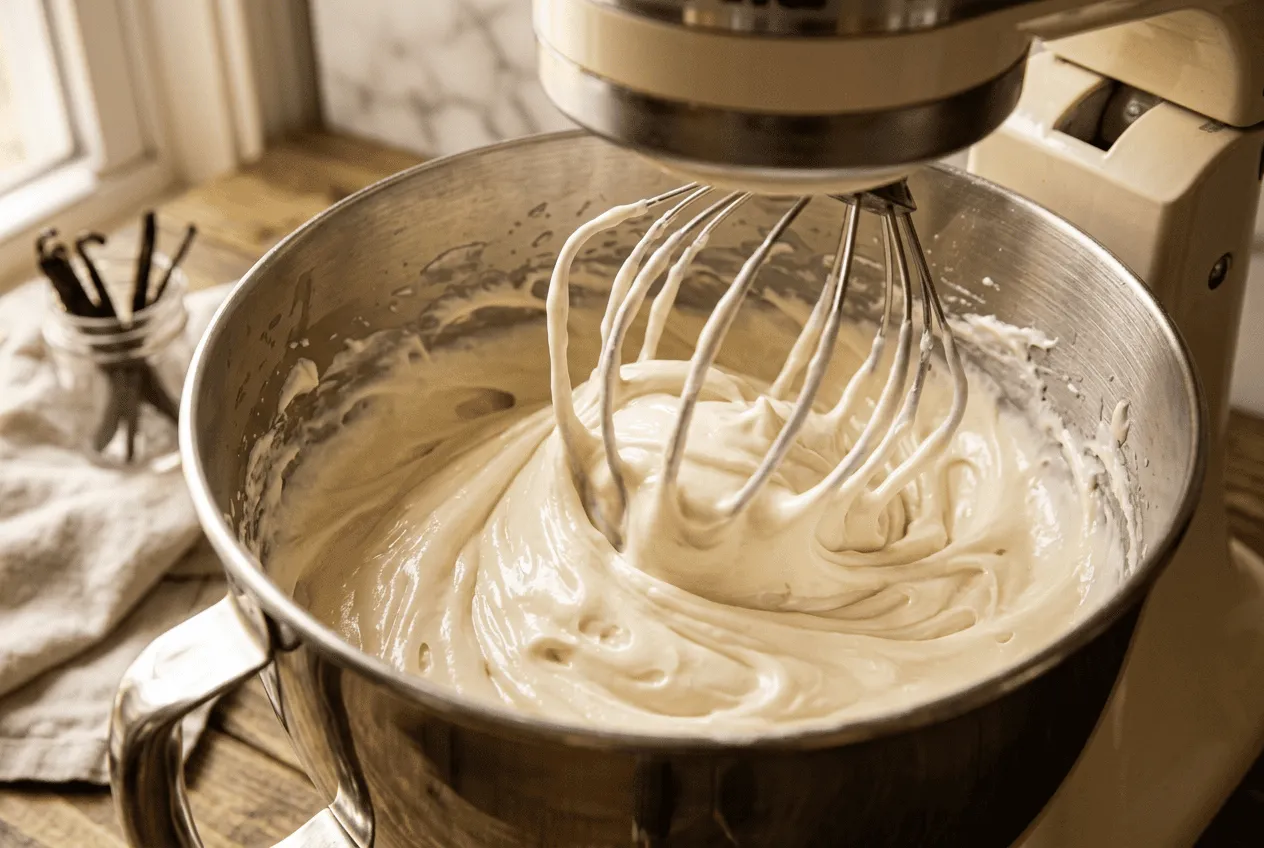
Many home bakers struggle with runny, soup-like cream cheese frosting. The secret lies in using the right ingredients and technique:
- Always use brick cream cheese, never spreadable cream cheese sold in plastic tubs. Tub cream cheese contains extra water and stabilizers that turn icing runny.
- Ensure your butter is softened to room temperature, but keep your cream cheese slightly cool.
Frosting Instructions:
In the bowl of your stand mixer fitted with the paddle attachment, beat 1 cup of softened butter on medium-high speed for 2 minutes until light and creamy. Cut the chilled cream cheese into small cubes and add them gradually to the butter. Beat on medium speed for another 2 minutes until perfectly smooth and free of lumps.
Reduce mixer speed to low. Gradually add the 4 and 1/2 cups of sifted powdered sugar, one cup at a time, allowing it to incorporate slowly. Add 2 teaspoons of vanilla extract and 1/4 teaspoon of salt. Once all sugar is added, increase speed to medium-high and beat for 1 minute until fluffy and creamy. If the frosting feels slightly warm or soft, chill it in the refrigerator for 20 minutes before spreading.
HOW TO ASSEMBLE AND DECORATE THE CAKE
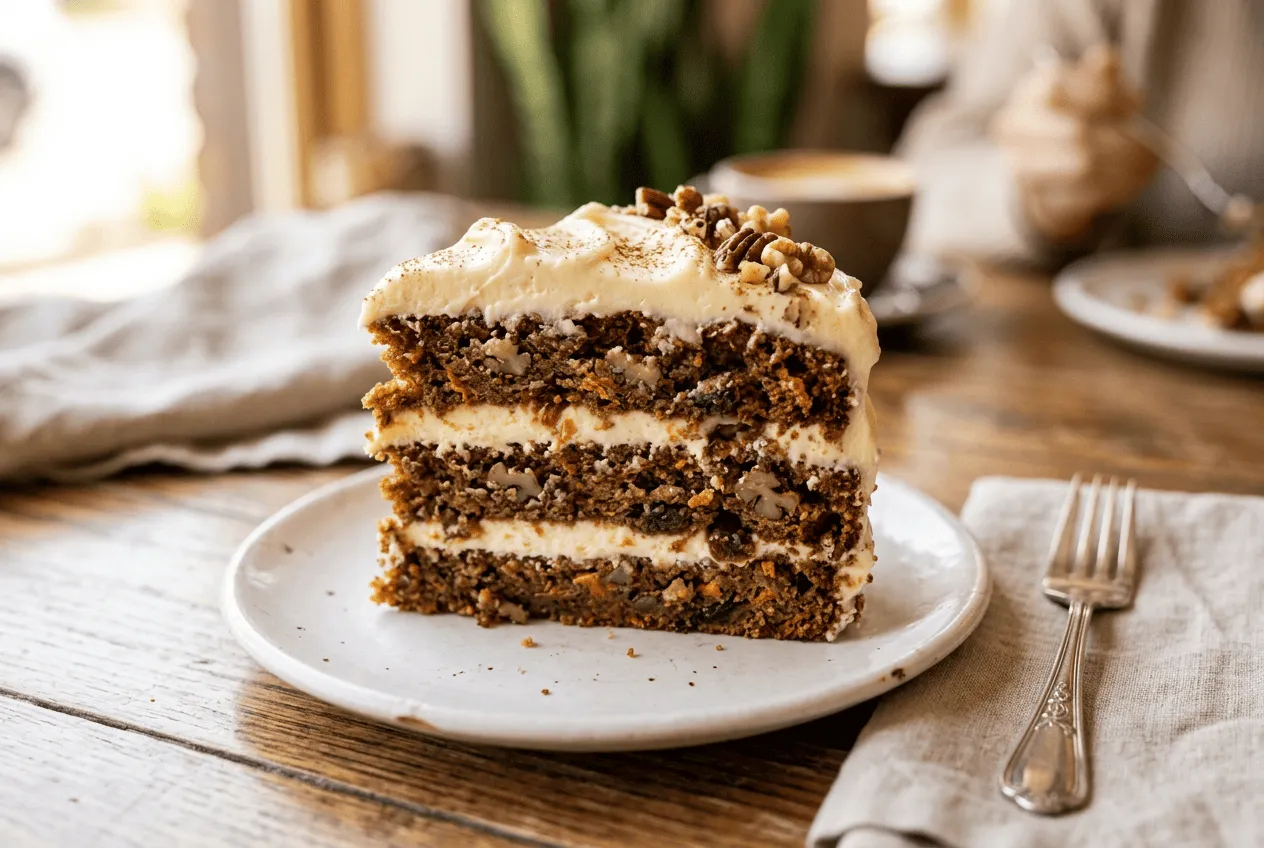
- Level the Layers: If your cooled cakes have rounded tops, slice a thin sliver off the top using a serrated bread knife to make them completely flat.
- Bottom Layer: Place a small dab of frosting onto the center of your cake stand or serving plate to prevent slipping. Set the first cake layer down, flat side down.
- First Filling: Spoon roughly 3/4 cup of frosting on top and spread it evenly out to the edges using your offset spatula.
- Second Layer: Place the second cake layer on top, press down gently, and spread another 3/4 cup of frosting across the surface.
- Top Layer: Place the third cake layer upside-down (so the flat, baked bottom becomes the smooth top of your cake).
- Crumb Coat: Spread a very thin layer of frosting over the top and all around the sides to trap loose crumbs. Place the cake in the refrigerator for 20 minutes to firm up.
- Final Coat and Garnish: Spread the remaining frosting generously over the top and sides, creating decorative swirls with your spatula. Garnish the top perimeter with chopped toasted pecans or walnut halves.
PRO BAKER SECRETS FOR MAXIMUM MOISTURE AND RISE
- Spoon and Level Your Flour: Never scoop flour directly from the bag using your measuring cup. This packs the flour down and adds up to 25 percent more flour than needed, resulting in a dry, heavy cake. Instead, fluff the flour with a fork, spoon it gently into the cup, and sweep across the rim with a flat knife.
- Fresh Baking Soda and Powder: Check the expiration dates on your leaveners. If they have been open in your pantry for over six months, replace them to ensure your cake rises tall and fluffy.
- Toasting the Nuts is Crucial: Raw nuts can taste bland and soggy once baked inside a moist cake. Toasting nuts for a few minutes releases their natural aromatic oils, ensuring a pleasant crunch and rich flavor.
DELICIOUS VARIATIONS AND CUSTOMIZATIONS
- Crushed Pineapple: Add 1/2 cup of canned crushed pineapple to the batter for extra natural sweetness. You must squeeze the pineapple thoroughly in a clean kitchen towel to remove excess liquid before adding it, or the cake center will sink.
- Shredded Coconut: Fold 1/2 cup of sweetened or unsweetened shredded coconut into the batter alongside the carrots for added texture.
- Carrot Cake Cupcakes: Line two 12-cup muffin tins with paper liners. Fill each cup three-quarters full. Bake at 350 degrees Fahrenheit for 18 to 22 minutes until a toothpick comes out clean. Yields 24 cupcakes.
- Simple 9×13-Inch Sheet Cake: Pour the entire batter into a greased 9×13-inch metal baking dish. Bake at 350 degrees Fahrenheit for 40 to 45 minutes. Cool completely and frost directly in the pan.
STORAGE, MAKE-AHEAD, AND FREEZING GUIDE
- Room Temperature: Because real cream cheese frosting contains dairy, a frosted carrot cake can sit at cool room temperature for up to 3 hours before serving.
- Refrigeration: Store the cake in an airtight cake carrier or covered under a large bowl in the refrigerator for up to 5 to 6 days. For best flavor, remove cake slices from the fridge 20 minutes before eating to let the frosting soften.
- Freezing Unfrosted Layers: Wrap cooled cake layers individually in two layers of plastic wrap and a layer of heavy aluminum foil. Freeze for up to 3 months. Thaw overnight in the refrigerator before frosting.
- Freezing Fully Frosted Slices: Place cake slices on a baking sheet and freeze uncovered for 1 hour until the frosting is firm. Wrap tightly in plastic wrap and foil. Thaw in the refrigerator for a few hours before enjoying.
COMMON MISTAKES AND HOW TO PREVENT THEM
- Why Did My Cake Sink in the Center?
Opening the oven door too early during the first 25 minutes of baking allows heat to escape and collapses the rising structure. Another cause is underbaking, or adding wet ingredients like undrained pineapple. - Why Is My Frosting Watery?
Using spreadable tub cream cheese instead of solid brick cream cheese is the number one cause of watery frosting. Liquid cream cheese has too much water content. Another cause is over-beating the frosting, which causes the fats to melt. - Why Is the Crumb Tough and Chewy?
Overmixing the batter once the flour is added activates gluten proteins, making the cake rubbery instead of soft. Fold the ingredients gently just until no dry flour is visible. - Why Did the Cake Stick to the Pan?
Failing to use parchment paper on the bottom of the pan is the main culprit. Always use pre-cut parchment rounds and allow the cakes to cool in their pans for 15 minutes before attempting to invert them.
FREQUENTLY ASKED QUESTIONS (FAQS)
Can I use pre-shredded carrots from the supermarket?
No. Packaged shredded carrots are too thick, dry, and coated with anti-caking starches. They will remain hard and crunchy after baking and will not release the moisture needed for a tender crum